

After Novelty Wears off, How can Companion Robots Actually be Put to Use?
After freshness is gone, how many of these companionship-oriented robots will stay and who are willing to pay for them?
NextFin News -- At Germany’s IFA show, the OlloBot team noticed that some kids figured out OlloNi’s touch-sensitive zones in just five to ten minutes—then they named it, talked to it, and even offered it their snacks.
Kids’ curiosity is easy to spark. The harder question is how robots enter the home and keep getting used—rather than ending up left in a corner, gathering dust.
LOVOT is a leading example of a cute, pet-like companion robot. GROOVE X has disclosed that from its launch in December 2018 through the end of June 2026—a span of seven and a half years—LOVOT recorded about 20,000 active contracts.
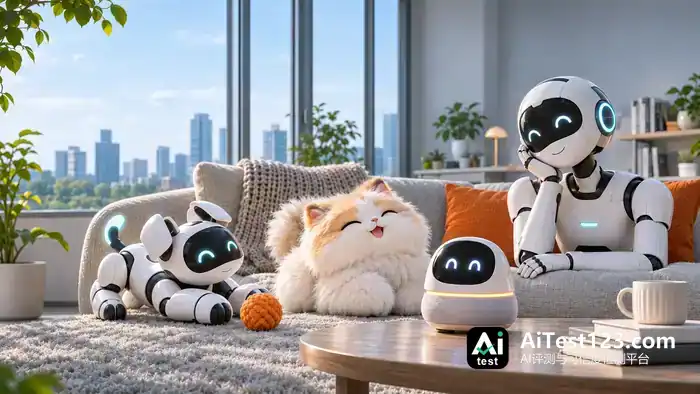
This year, a wave of companion robots in very different forms poured into the track: cyber pets that can walk around on their own, plush toys you can hug, and full-size humanoid robots with synthetic skin.
On June 30, UBTECH’s UWorld released the U1 series of full-size companion robots; in July, Xinyan Group’s robot “Babu” made its first public appearance at WAIC 2026; and in September, pet-style companion robots such as Woan’s KATA Friends and Huichang Technology’s OlloBot debuted at IFA.
Unlike embodied-intelligence products that compete on their ability to do chores, these products rarely pitch household-task capability as the selling point. Instead, they focus on emotional interaction, entertainment, tactile experiences, and in-home care—hoping these “soft services” will earn them a lasting place in the household.
Six Different Types of Buyers
Under the umbrella of “companion robots” sit product types whose needs and capabilities vary widely.
There isn’t a single, universally accepted taxonomy. Based on the core reasons people buy them, they can roughly be grouped into six categories: cute, pet-like emotional companionship; entertainment and interactive toys; child development and education; care and safety monitoring; multi-purpose; and humanoid companionship.
Among these, cute, pet-like emotional companionship is where innovation has been especially concentrated. Japan’s LOVOT, Sony’s aibo, and Casio’s Moflin—as well as China’s OlloBot, KATA Friends, Babu, Loona, Ropet, and others—all aim to build long-term relationships with consumers through pet-like form factors, emotional feedback, and “personality” development over time.
The differences in form factor and cost are stark. Moflin and Fuzozo create a sense of companionship through a plush touch, sounds, and simple movements; LOVOT, OlloBot, and similar products require autonomous mobility, environmental perception, and motion control.
Entertainment and interactive toys—represented by Eilik and EMO—focus on character design, facial expressions, and game-like interactions. In the growth-and-education space, there are products such as Miko and Moxie. Care and companionship for seniors includes ElliQ and Hyodol, as well as PARO, an assistive therapeutic robot.
Shangwei New Materials’ Qiyuan and Songyan Power’s Xiaobumi, among others, take a compact, playable, and modifiable approach—combining companionship with programming education, content creation, and embodied operation—placing them in the designer-toy and platform category. Humanlike companionship is another direction many embodied-intelligence companies have been betting on, developing ultra-bionic humanoid robots positioned around emotional companionship, such as UBTECH’s You World U1 series and Realbotix’s humanlike companion robot Aria in the U.S.
Different routes reflect different views on how families and robots should build relationships.
Fang Yilin, General Manager of Huichang Technology and CEO of OlloBot, told Chuhai Cankao that “when the team first considered a home-robot product, we believed there was still a long technological distance to go before robots could handle complex household chores, while simple AI toys are easily left unused after the initial short-term novelty. So in the end we chose a more family-friendly cyber pet as our entry point.”
This has also become a common choice in today’s home-robot industry: when household-labor capabilities are not yet mature, companies try to get robots into homes first through companionship.
Beyond differences in product route, attitudes in the capital markets have also shifted.
When the market was hot, both new entrants and capital poured in. According to statistics from IT Juzi, in the first half of this year the domestic embodied-intelligence track saw RMB 93.5 billion in financing across 322 deals—about five times the amount in the same period last year (companionship is not tracked separately for now, so cross-industry embodied-intelligence data is used as a reference). The companionship direction also received a share: Luobo Intelligence completed a Pre-A round of over RMB 100 million early this year; SoulX secured tens of millions of RMB in angel investment from GL Ventures.
As the third quarter began, the pace of capital slowed. Citing a roundup by Yicai, disclosed embodied-intelligence financing in Q3 2026 totaled about RMB 33.3 billion, lower than the roughly RMB 46.7 billion per quarter average in the first half of the year. Using that first-half quarterly average as a benchmark, the number of deals Sequoia China participated in fell from about 10 to 8, while Hillhouse Ventures dropped from about 9 to 4.
On the one hand, there’s less money; on the other, where it goes has become more concentrated. Data from ITjuzi shows that in the first half of the year, around 70% of funding flowed to the top 20 companies. Firms in the second and third tiers are finding it hard to secure fresh funding. Back to companion products: after researching AI companion toys, one investor said that “the ongoing experience of some (non–top-tier) products is pretty average.”
One of the criteria Sequoia China Managing Director Li Yannan offered is this: whether an AI hardware product is worth investing in hinges on whether the device can proactively sense its environment, understand information, and respond accordingly—it can’t remain stuck at the stage of merely waiting for users to issue commands.
With Curiosity Gone, What Keeps Companion Robot Relevant?
At IFA, a child’s curiosity for a few minutes is only the trigger point; the real challenge is how a companion robot can be switched on frequently and used by families over the long term.
Fang Yilin told Chuhai Cankao that OlloBot focuses more on steady interaction over 7 days, 30 days, 90 days, and even 360 days. To increase engagement, OlloBot is designed for proactive interaction, having the robot approach its owner and other family members on its own—like a pet would.
To fit the “pet” positioning, OlloBot doesn’t answer questions directly in human languages like Mandarin or English the way most AI assistants do. Instead, it has created a unique “electronic pet” language of its own. Users need to infer meaning from its sounds, movements, and the expressions on its screen, gradually becoming familiar with its personality.
Fang Yilin explained: “The team seriously debated whether to let the robot speak human language directly, but if a pet turns into an assistant that answers every question, it loses what makes it a pet. Users need to actively explore and understand the robot in order to form a relationship that’s different from using ordinary smart devices.”
Japan’s LOVOT has also been trying to build long-term interaction through proactive approach behaviors, body warmth, tactile feedback, and behavioral changes. Woan’s KATA Friends, meanwhile, emphasizes autonomous mobility, proactive interaction, and remembering family members.
All of these designs aim to ensure that robots no longer can only wait passively to be “woken up” by users. But as proactive interaction becomes a shared capability of more and more companion robots, a new challenge emerges: how to strike the right balance between being proactive and being intrusive.
Fang Yilin told us that OlloBot chooses when to initiate interaction based on the owner’s daily habits, changes in the environment, and its own personality mechanisms. But if the owner is busy or refuses to engage, the robot also needs to stop promptly.
Ren Yongliang, founder of Xinyan Group, gave the robot Babu a sense of “agency,” so it doesn’t simply go along with whatever the child says. This kind of “friction” helps keep kids connected to real-world social interaction.
In addition, emotional interaction is not the only way to increase usage frequency.
The OlloBot team is exploring elderly companionship, family video calls, and memory logging. For example, the robot could look for an elderly family member at home and help them place a call to relatives living elsewhere; or it could collect an elder’s life stories through long-term conversations and compile them into a memoir. Xinyan Group’s Babu, relying on a flexible architecture, allows features that the company didn’t explicitly design to “grow” out of households and users.
These services and functions don’t conflict with emotional companionship. An emotional bond may increase users’ willingness to accept a robot, while concrete household services can create reasons for it to be used again and again.
But that also raises the bar for service reliability. For video recording, remote communication, and elder care, there are already mature software and hardware products on the market. Companion robots must not only add features, but also prove they can deliver a different experience.
Data from day 7, day 30, day 90, and day 360 will only emerge after the robots enter a large enough number of households. Before then, the only thing the industry can really point to is sales volume.
Beyond Companionship, Any Other Selling Point?
Desktop companion robots were the first to open up the market, thanks to higher sales.
Luobo Intelligence’s Fuzozo disclosed that its cumulative global sales were nearly 300,000 units; Loona’s official website disclosed cumulative global shipments of more than 130,000 units; and in a report published in April 2026, Ropet’s cumulative sales were about 20,000 units.
The ground-based wheeled mobile robot LOVOT, which starts at nearly US$4,000 (RMB 30,000), had only around 20,000 units in service as of the latest available figures.
Products with relatively simpler mechanical structures and lower prices find it easier to reduce the barrier to a first purchase. Products that must move autonomously require higher costs for structure, sensors, and control systems, and their prices tend to rise accordingly.
OlloBot’s development process reflects the same trade-offs. The team initially designed both a long-neck and a short-neck version, but the long-neck model would have required additional sensors and obstacle-avoidance design, as well as controls to mitigate safety risks from tipping over. In the end, they chose the short-neck version and pushed it into mass production.
Fang Yilin noted that mechanical transmission systems, compute modules, and customized components are major contributors to OlloBot’s hardware costs.
Beyond hardware, companion robots are also exploring revenue streams from accessories and subscriptions.
LOVOT has already built a model that combines clothing, accessories, and monthly services. OlloBot has designed replaceable plush outer shells and outfits, and Ropet has also tried to launch personalized products through IP collaborations.
This is closer to spending on pet supplies and designer toys: consumers may not only buy the robot itself, but also be willing to pay extra for its appearance and character identity.
Software services, however, face a different set of challenges. KATA Friends ties its AI companionship features to paid service plans; LOVOT covers software and maintenance through long-term service plans. OlloBot plans to handle basic interactions on-device, so core functionality would still work without a subscription, while features such as family vlogs, content generation, and memory storage would require a paid subscription.
Fang Yilin revealed that “under the heavy-usage scenarios the team modeled, an AI service with unlimited tokens could cost on the order of tens of U.S. dollars per month.” That said, this was still an internal estimate for specific usage scenarios, not an actual average cost or subscription price.
While different companies price differently, they all ultimately have to answer the same question: what kind of service are consumers willing to keep paying for?
Services like education, caregiving, and home security already have clear pay-for scenarios, but they also face competition from phones, smart cameras, and other household devices. Whether personality development, emotional interaction, and long-term memory can independently sustain a subscription model still lacks sufficient market validation.
Zhang Fumin, a Chair Professor at the Hong Kong University of Science and Technology and Chief Scientist at Shadow Robotics, previously said that intelligent emotional companionship could be one of the earlier directions in which embodied intelligence achieves scaled adoption—but that an ideal product state would still require three to five years of technological iteration. The commercialization path he proposed is to first validate the product in small batches within typical application scenarios with relatively high tolerance, and then gradually expand into the mass consumer market.
This shows that while there are business opportunities for companion robots, they cannot skip over product delivery and real-world usage validation.
Both software subscriptions and repeat accessory purchases depend on hardware first reaching a sufficiently large number of households. Only after devices are sold can the full costs and profits of software maintenance, content updates, and after-sales service be properly calculated.
Overseas markets introduced new uncertainties.
In July 2026, the U.S. FCC added foreign-made advanced robots that meet specific criteria to a restricted list and would not grant market-entry authorization for related new robot models. This rule impacted the global robotics industry.

OlloBot had originally planned to launch its Kickstarter crowdfunding campaign in August, but the plan did not move forward on schedule. Fang Yilin told Outbound Reference that the U.S. is OlloBot’s key target market; the company is currently working on policy-response options while prioritizing progress in the European market.
Under the latest roadmap, OlloBot will still head to the U.S. to attend CES 2027, and expects to complete the first batch of deliveries in Q1 2027.
The children at IFA who picked up OlloBot and started playing with it on the spot proved the value of novelty, while the sales and usage data at 7, 30, 90, and 360 days will only become available after CES.